Introduction
The OU-MB: The OU Multimodal Biometric Database and Its Performance Evaluation is meant to aid research efforts in the general area of developing, testing and evaluating algorithms for multimodal biometrics. The D3 Center, the University of Osaka (OU) has copyright in the collection of the 11 biometrics data and serves as a distributor of the OU-MB dataset.
The OU-MB was collected in 2024 and 2025 in an open laboratory office environment with easy public access. Participants, ranging from primary school students to adults, were recruited from the general population to ensure diversity between age groups and social backgrounds. The dataset follows a single-session acquisition design, where each participant completed all data collection procedures during a single visit day.
During data collection, iris images, palm vein images, full-body images, facial images, offline signature images, online signature time-series data, speech recordings, gait data, brain signals, inertial sensor data, and health-related data were individually captured for each participant under relatively controlled acquisition conditions. The capture devices and example data samples for each biometric modality are illustrated in Figure 1.
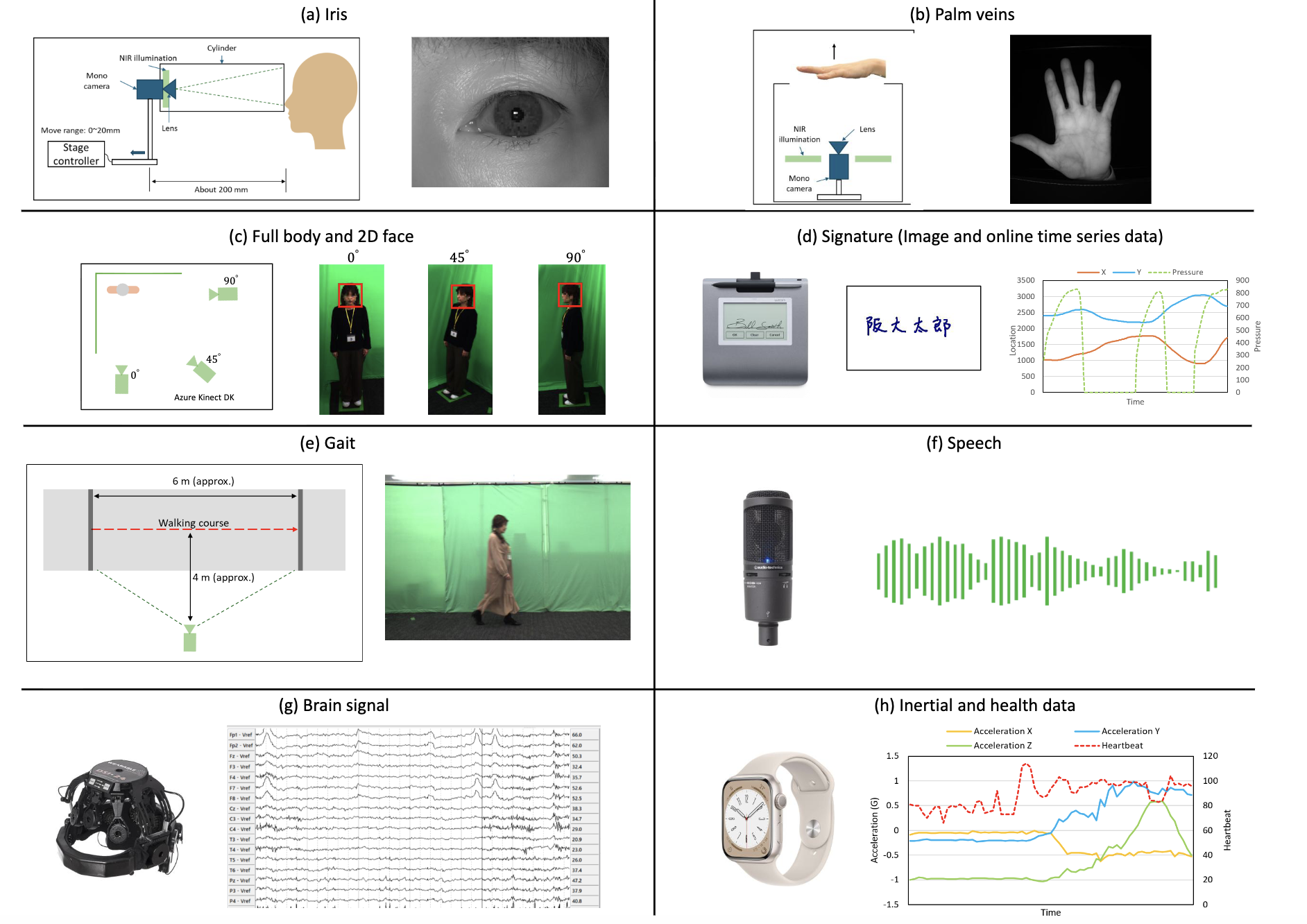
Fig. 1: Capture devices/setups (left) and sample data (right) for each biometric modality in OU-MB.
The detailed descriptions are found in the following paper.
- C. Xu, X. Li, A. Shehata, M. Aljazaerly and Y. Yagi, "OU-MB: The OU Multimodal Biometric Database and Its Performance Evaluation", IEEE Transactions on Biometrics, Behavior, and Identity Science (T-BIOM), 2026. [Bib]
Dataset
The proposed database includes 1,099 subjects. Participants were recruited across a wide age range, comprising 787 females and 312 males, with ages ranging from 7 to 82 years. The database contains 11 biometric modalities. Ten modalities are available for all 1,099 subjects, while brain signal (EEG) data are available for a subset of 557 subjects. This partial coverage was due to the experimental design, as EEG acquisition requires additional setup time, specialized equipment, and higher participant compliance compared to other biometric modalities.How to get the dataset?
To advance the state-of-the-art in multi-modal biometric recognition, this dataset could be downloaded as a zip file with password protection and the password will be issued on a case-by-case basis. To receive the password, the requestor must send the signed release agreement to the database administrator by mail, e-mail, or FAX.- Release agreement
- Dataset (The download URL and password will be provided once your application is approved.)
The database administrator
Yagi Lab., iLDi, D3 Center, the University of OsakaAddress: 8-1 Mihogaoka, Ibaraki, Osaka, 567-0047, JAPAN

FAX: +81-6-6879-4032.